'Fighting terrorism and doing away with the safe shelters, sanctuaries, and safe havens will be an important part of our cooperation.'

'We're going to see a defence relationship that really takes off -- now that India is a major defence partner of the US, the sky is the limit for arms sales.' 'The economic partnership will lag behind the security relationship, but the meeting and joint statement give cause to believe that it will progress more robustly than many of us would have expected.'
'This was the first ever visit by a President in a re-election year so it sent a strong signal of the priority of the relationship and the desire to continue to strengthen it.'

The joint statement issued after Prime Minister Narendra Modi and President Barack Obama's first-ever summit is high on intent and ambition. Notably missing from the statement is India's refusal to be America's partner in its war against ISIS.
Modi may take satisfaction from his display of considerable political skill in managing a mercurial, temperamental and unpredictable US president and nudging him into uncharacteristic restraint and even carefully orchestrated remarks. This personal chemistry will come in handy if Trump returns as president in the November elections, says former foreign secretary Shyam Saran.

Recognising the threat posed by outfits like the Al Qaeda, Lashkar-e-Tayiba and the Dawood Ibrahim network, India and the United States have agreed to deepen cooperation in fighting terrorism and asked Pakistan to bring to justice the 2008 Mumbai attack perpetrators.
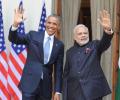
Modi and Obama surely put India-US ties in fast-forward mode. But 5 things deserve careful attention.
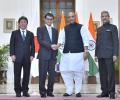
The India-Japan 2+2 dialogue added strategic heft to the special relationship in the wake of growing Chinese assertiveness on regional affairs, points out Dr Rajaram Panda.

The prime minister and president stated their intention to expand defence co-operation to bolster national, regional and global security.
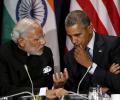
'Big countries do not agree on every set of issues.' 'Look, one of the differences in the relationship is that when we do not agree, we are sitting down and talking to each other.'
Prime Minister Narendra Modi and United States President Barack Obama will meet on Sunday, January 25, at Hyderabad House a few hours after the American leader's arrival in New Delhi.

'It is in the interest of both sides that the visit of the US President is seen as being successful. Both sides have invested considerable political capital in it. This rapid exchange of visits and the decisions taken have to be justified, beyond the symbolism, which is no doubt important in itself. This opportunity to impart a fresh momentum to ties should not be missed,' says former foreign secretary Kanwal Sibal.

'Progress demands regular senior-level attention from American leaders.' 'A leaders' summit is great, but we need sustained engagement to continue to forge new agreements and find new areas of cooperation.'

So, how does Pompeo's check list look like? In a broad sense, he is coming here 'to make sure that we have economic openness'; to ensure that 'we have to deliver'; to understand that 'we have to execute' what we promised to do; and, to 'broach some tough topics', points out Ambassador M K Bhadrakumar.

Ahead of Russian President Vladimir Putin's India visit, the United States has said it would not impact President Barack Obama's trip to the country in January but warned now was not the right time to do business with Russia.

'It is crucial today to realise where we have reached in this 15 year-period in order to fully and properly assess the profundity of what General Rawat has said,' points out Ambassador M K Bhadrakumar.

Pakistan-based terrorist outfits like Lashkar-e-Tayiba are likely to turn their attention to India with the drawdown of US forces from Afghanistan, a top Pentagon commander has told lawmakers.

Tillerson said the US will provide India with best technologies for its military modernisation which include offers to supply F-16 and F-18 fighter jets.

Jaishankar said that the resolution on Kashmir introduced by Jayapal in the House is not a fair characterisation of the situation in J-K. And also said that he has no interest in meeting the Congresswoman.

United States President Barack Obama will have a tight schedule during his three-day visit starting January 25, as he will hold talks with top leadership in New Delhi on ways to make progress on key issues like defence and civil nuclear agreement and attend the Republic Day celebrations as the chief guest, among other engagements.

'To expect that he has a magic wand to resolve all differences and announce breakthroughs in all issues during his first visit to the US is to be unrealistic,' says Ambassador T P Sreenivasan.

He also said that the Obama Administration has not expressed any objection to the recent signing of a pact by India and Iran to develop the Chabahar port, despite some concerns expressed by a few Senators.

Sujatha Singh is the third senior official to have been dismissed by NDA.

'... For the India-US relationship to continue its positive trajectory, it will require India to adapt to a different approach.' Nisha Desai Biswal -- who as the Obama administration's point person for South Asia was in the inner circle of all the Obama-Modi Summits -- tells Rediff.com's Monali Sarkar why she is hopeful that India and the US are on an irreversible forward course.

'If there's one administration that would be likely to put the squeeze on Pakistan, it's the Trump administration.' 'This is an administration that views terrorists as a black and white issue (kill them all, no questions asked), and will have little patience for Pakistan's selective policy toward terrorism.'

'The book has immense value because it reveals the inner workings of the think-tank which appears to provide facts and insights to Modi, though he himself takes the final decisions and articulates them in his characteristic rhetorical style,' says Ambassador T P Sreenivasan.
It is in Prime Minister Narendra Modi Modi, officials in Washington believe, US President Barack Obama has found an Indian leader who is willing to walk the talk to realise the common goals of the two countries. Lalit K Jha reports

Praising the US for turning barriers into bridges of partnership, he said that America had stood with India when the support was needed the most, like when terrorists attacked Mumbai in November 2008 and in other economic endeavours as well
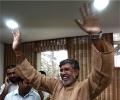
'Today, when Kailash Satyarthi is being honoured with the most prestigious global award, reports appear to the effect that many millions of Indian children are in 'slavery'. This is hardly the reputation that India should have when we are basking in the glory of 'Mangalyan',' says T P Sreenivasan.

Rediff.com reproduces this 2014 interview with Tim Kaine where in he discusses the new opportunities to foster Indo-US trade and the improvement in ties.

'The interests of the United States and India are sharply aligned on the issue of Pakistan-based terrorism.'

'If the dimensions of the strategic partnership worked out by India and the US seem like a grand alliance targeted at you-know-who, China had better realise that it has fathered it,' says B S Raghavan, a long time observer of China.

As Japan beefs up its defences against China, both New Delhi and Tokyo seem to have decided to re-energise their relationship to ensure a strategic balance in Asia. It is a clear signal that they may be ready to work together in containing if not confronting China, says Nitin Gokhale.

New book claims Amar Singh gave between 20 and 100 per cent of his entire net worth to the Clinton Foundation.

'We have a common way of looking at the world, a common way of thinking, and a common set of values that predispose us to be partners. And our interests overlap greatly,' Dr Ashton B Carter, America's next defence secretary, told Aziz Haniffa/Rediff.com in an exclusive interview.

In bilateral interfaces relations with China have also to be given due weight, opines Premvir Das

Even as the United States snuggles closer to India with the thinly veiled objective of containing China, the Indian strategy is to avoid alienating either nation.

'Whether it's investments in Kashmir, building naval facilities, or selling top-of-the-range military equipment, Pakistan could well benefit more under Xi's watch.' 'Do Chinese concerns about the 'Islamisation' of Pakistan give it pause about how quickly to move forward with security and economic projects? At the moment the indication is quite the opposite: China is doubling down on its support to Pakistan, partly because of its fears about where the country is headed.'

A sensational interview on India-China ties, with the man most qualified to answer.
 © 2026 Rediff.com - Advertise with us - Disclaimer - Privacy Policy - Sitemap - Feedback - About us - Terms of use - Grievances